

Before anyone opens your walls or electrical panel, check the contractor’s active license. Search results mix electrical businesses, lead-generation marketplaces and people advertising repairs. A “master electrician” title alone does not establish that someone is licensed to contract for your job. Florida requires an electrical contracting business to be qualified by a properly licensed individual contractor. MyFloridaLicense.com
Unlicensed contracting is a local problem. In June 2023, Hillsborough County deputies arrested 22 people during Operation Hot Water. Investigators posed as homeowners seeking electrical and plumbing work involving a water heater. The sheriff’s office reported missing contractor licenses or proper insurance. This was a contractor sting, not 22 arrests of electricians alone.
Urgency makes the decision harder. You have flickering lights, an inspection deadline or a generator project before a storm. Then a quote arrives without explaining the permit, service-call charge or hourly minimum.
No active license, no job.
This guide gives you a five-minute license check, explains what to ask about permits and insurance, and helps you compare written quotes line by line. Confirm permit requirements with the city or county responsible for your address.
It is for Tampa-area homeowners, landlords and new buyers arranging repairs, panel upgrades, surge protection, generators or EV chargers. It does not rank electricians. It shows you what to check before choosing one.
Pre-Hire Check at a Glance
Check these five things before authorizing work or paying a deposit. A license number in an advertisement is only the starting point.
| Check | What to ask or look up | Walk away if |
|---|---|---|
| License | Search DBPR. Confirm active status, expiration, license scope and the business it qualifies. For ER licenses, confirm the authorized location. | The license is missing, inactive, expired or unrelated to the business quoting your job. |
| Insurance | Request current liability coverage and workers’ compensation coverage or a valid exemption. Confirm who the exemption covers. | They refuse proof or cannot explain coverage for the crew. |
| Permit | Ask who will pull the permit and include its cost. Confirm requirements and contractor registration with the city or county for your address. | They dismiss permits for a panel change, rewire or new circuit and refuse confirmation from the permitting office. |
| Written quote | Get the scope, labor, materials, permit fees, service-call charge and hourly minimum in writing. | They offer only a verbal total or refuse a written scope and receipt. |
| Payment | Agree on documented payments tied to progress. Match the payee to the contracting business. | They demand a large cash deposit, full payment before work or payment to an unexplained third party. |
DBPR explains license scope and business qualification, and its electrical licensing checklist addresses insurance. Tampa publishes trade-permit guidance and a contractor registration form. Confirm the requirements for your specific job and address.
Your Electrician Is Not Tampa Electric
You choose your electrician. Your address determines your electric utility. Tampa Electric serves much of the Tampa area and operates under Florida Public Service Commission regulation. Use the PSC’s utility service map to check the provider for your property.
Florida does not offer ordinary residential customers a competing retail electricity supplier to switch to. Guides comparing suppliers’ fixed-rate contracts and variable-rate plans describe markets with retail choice. They are not instructions for choosing a Tampa electrician. A proposed energy-choice amendment was kept off Florida’s 2020 ballot by the state Supreme Court.
| Who you need | What they handle |
|---|---|
| Your electric utility | Electricity supply, outage reporting and utility-owned service equipment. |
| A licensed electrical contractor | Repairs and installations involving customer-owned wiring, panels and equipment, within the contractor’s license scope. |
| Both, working together | Projects involving service changes, meter work or reconnection. Ask who coordinates each step. |
The meter is not a complete ownership boundary. Tampa Electric says customers are responsible for the weatherhead, riser and meter box, while the utility handles its meter and service line. Some customer-owned equipment sits before the meter.
For a service upgrade, ask the electrician what requires utility coordination. Tampa Electric’s service requirements call for advance notification when a service change is being considered. Confirm the process with the utility and permit requirements with the city or county.
Report an outage through your utility’s official channels. An unsolicited caller offering “power company” repairs is not proof of utility authorization. Verify independently before agreeing to work or payment.
When you call Tampa Electric about an outage, you are calling the utility. Do not hire a "power company" that phones you.
Emergency or Can It Wait?
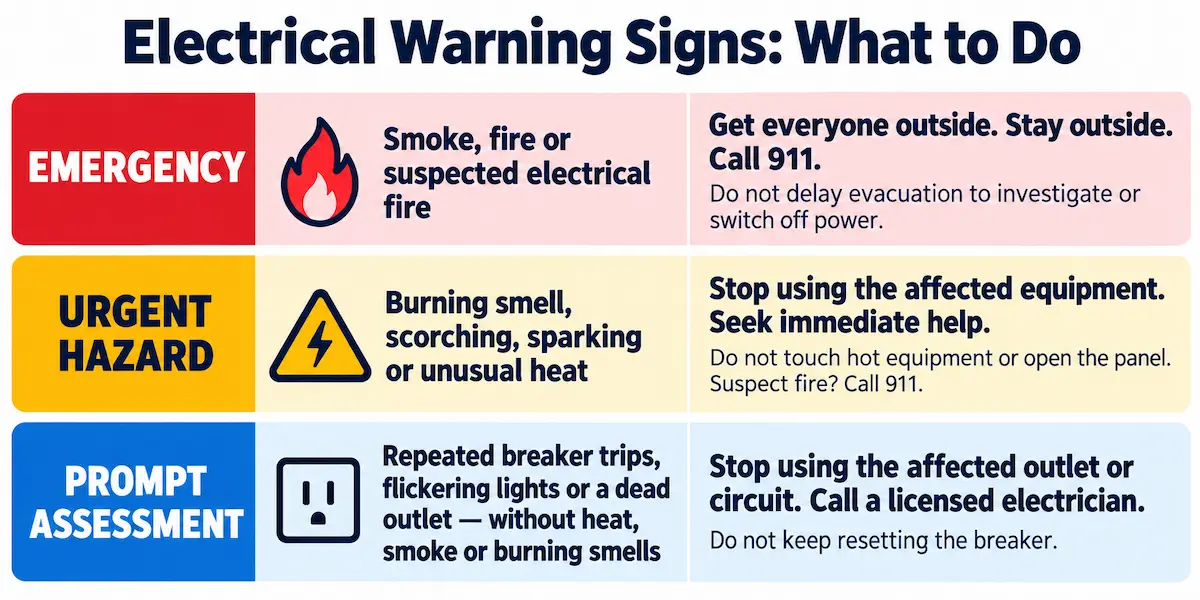
Check for danger before comparing emergency rates. Smoke, a burning smell or overheating needs immediate attention. A planned installation can wait for written quotes. Flickering lights and repeated breaker trips need assessment; do not assume they are harmless.
| Situation | Treat it as | What to do |
|---|---|---|
| Smoke, fire or suspected electrical fire | Emergency | Get everyone outside, stay outside and call 911. Do not delay evacuation to investigate or switch off power. |
| Burning smell, scorching, sparking or an unusually hot panel | Urgent hazard | Stop using the affected equipment. Do not touch hot equipment or open the panel. Seek immediate help; call 911 if you suspect fire. |
| Repeated breaker trips, flickering lights or a dead outlet, without smoke, heat or burning smells | Prompt assessment | Stop using the affected outlet or circuit. Do not keep resetting the breaker. Call a licensed electrician, describe the symptoms and ask how urgently they need to attend. |
| An outage affecting nearby homes too | Utility issue first | Report it through your utility’s official channels. Stay away from fallen wires. |
| A new fixture, ceiling fan, outlet, surge protector or EV charger, with no existing hazard | Planned work | Get comparable written quotes and confirm permit requirements with the city or county. |
The Electrical Safety Foundation International identifies flickering lights, warm outlets, discoloration, buzzing and burning smells as reasons for professional inspection. NFPA also flags frequent breaker trips. These are warning signs, not a diagnosis you can make from a table.
Ask for the after-hours rate before dispatch once immediate danger is addressed.
Angi’s Tampa guide, dated March 9, 2026, estimates emergency rates at 126–253 an hour, roughly double its standard range. Ask about the service-call charge, hourly minimum and diagnostic fee too.
Angi reports 36.4% of switch, outlet and fixture jobs in its customer data as emergencies. That is not a Tampa-wide safety statistic and does not establish whether your problem can wait.
Check the License in Five Minutes
No active license, no job.
Ask for the license number before booking. Then check it yourself through DBPR’s license search. A number printed on a truck does not establish its current status, scope or connection to the business giving you a quote.
Florida licenses individual electrical contractors who qualify businesses. That is different from issuing a state credential to every electrician on a crew. DBPR does not regulate journeyman licenses; local jurisdictions handle those credentials. A “master electrician” title alone does not prove authorization to contract for your project.
| License | Plain-language meaning | Your check |
|---|---|---|
| Certified electrical contractor EC | A statewide contractor license with broad electrical scope. | Confirm active status and that the contractor qualifies the business quoting your work. |
| Registered electrical contractor ER | Authorization limited to the cities or counties for which the registration was issued. | Confirm that it covers your property’s jurisdiction. A nearby business address is not enough. |
| Certified specialty contractor ES | A license covering a specific segment of electrical or alarm work. | Read the exact specialty. It may cover residential electrical work, limited-energy systems or another defined scope. |
DBPR also lists ET for registered specialty contractors. Those licenses have both scope and location limits. The prefix helps you start the check; the full license category determines what work is covered.
Follow These Five Steps
- Get the legal business name and license number.
- Ask who holds the license and who qualifies the company. Keep that information with the written quote. If the company uses a trading name, ask how it connects to the legal business.
- Open DBPR and select the search method.
- The search page offers “Search by Name” and “Search by License Number.” Use the number when available. A name search can return several people or businesses, so do not stop at the first similar name.
- Check the status and license type.
- Review the result’s “Status/Expires” information. Use DBPR’s linked glossary if a status is unclear. An inactive license is not permission to perform contracting work. For an ER or ET license, confirm the authorized jurisdiction with DBPR and the local licensing office.
- Check expiration and available complaint or discipline information.
- DBPR says certified and registered electrical and alarm contractors renew on August 31 of even-numbered years. The 2026 deadline has passed; the next regular renewal date is August 31, 2028. If the record still shows August 31, 2026, pause and confirm its status with DBPR rather than accepting a renewal receipt alone.
- The results page instructs users to click the name for additional information, including complaints or discipline. Read any available records carefully. A complaint is not automatically a finding against the contractor.
- Match the record to the company you are hiring.
- Compare the license number, qualifier and business information with the quote. A qualifier’s personal name can differ from the company name, but the connection must be verifiable. An address difference needs clarification; it is not automatically proof of wrongdoing. DBPR requires the licensed contractor to be approved to qualify the business entity.
Do not let someone else’s valid license end your check.
Save a dated screenshot and attach it to the quote. Recheck before work begins if there is a delay.
You can also browse local home repair businesses. A directory listing starts your search; it does not replace license verification.
Insurance and Workers’ Compensation
Ask for proof, not a promise. Before work starts, request current insurance documents that match the company on your written quote.
DBPR’s electrical-contractor licensing checklist requires public liability and property damage insurance, plus workers’ compensation coverage or an exemption. An active license is a starting point; verify the insurance separately.
| Ask for | What to check |
|---|---|
| Certificate of liability insurance | The insured business name, insurer, policy number, coverage types and effective dates. Ask the agent whether the policy covers the electrical work proposed. |
| Workers’ compensation evidence | Look up the business through Florida’s official proof-of-coverage database. Confirm the policy covers the dates of your job. |
| Exemption certificate, if claimed | Verify the named person and business through the state’s exemption search. Ask who else will work at your property. |
| Subcontractor information | Ask which company employs each crew and request relevant coverage documents before those workers arrive. |
Check the Exemption Carefully
An owner’s exemption does not exempt the whole crew.
Florida’s Division of Workers’ Compensation says exemptions are issued to eligible corporate officers or LLC members not to businesses. The exempt person excludes themselves from workers’ compensation coverage and cannot recover those benefits. Construction employers with one or more employees generally need coverage for non-exempt employees. “The owner is exempt” does not explain how an employee or helper is covered.
- Request the documents before authorizing work.
- Use the Florida DFS coverage and exemption lookup tools.
- Ask the insurer’s agent to confirm anything unclear, using independently verified contact details.
- Keep the documents with your quote and contract.
A certificate does not guarantee that every claim will be covered. If names, dates or crew arrangements do not match, pause until they are explained.
Permits in Tampa: City or County?
For a panel change, new circuit or hardwired charger, expect a permit and inspection to be part of the job. Confirm the exact requirements with the office responsible for your address before work begins.
Start with the property’s jurisdiction. A “Tampa” mailing address does not automatically mean the home sits inside City of Tampa limits.
Confirm the Work, Not Just the Project Name
Describe what will change. “Install a charger” could mean plugging equipment into an existing suitable receptacle or adding wiring, a circuit and hardwired equipment. Those are different scopes.
Ask the permitting office about:
- Panel replacement or service-capacity upgrades.
- Full or partial rewiring.
- New circuits or receptacles.
- A hardwired EV charger or a new charging circuit.
- A permanently installed generator, transfer switch or generator connection.
Tampa’s electrical guidance covers construction, alterations and repairs. Do not assume a small job or like-for-like fixture replacement is exempt without checking. Hillsborough County also publishes specific residential backup-generator requirements and identifies electrical trade permits for qualifying installations.
“We never pull permits for that” is a reason to pause.
If an electrician dismisses a permit for a panel upgrade, ask the office yourself. Get the answer for your address and proposed scope.
Put Responsibility in the Written Quote
- Name who will pull the permit.
- For a contractor-hired installation, have the electrical contractor handle the application. Ask them to confirm that their license and insurance records satisfy the local permit system’s requirements. Tampa publishes contractor registration forms and guidance; confirm the current process with Construction Services. www.tampa.gov
- Include the permit cost and inspection arrangements.
- Ask whether the quote includes application fees, required inspections and correction visits. Do not accept “permit extra” without an explanation of how the charge will be calculated.
- Get the permit number before permitted work starts.
- Check that the record matches your address, contractor and work. An application submitted is not necessarily a permit issued.
- Agree on the inspection and completion steps.
- Ask which inspections are required and who schedules them. For a charger, confirm with the office when testing or energizing is permitted. Do not assume installation alone means it is cleared for use.
- Keep the final approval record.
- Tampa says work requiring a permit must receive inspection and final approval. Request the final inspection result and confirmation that the permit is closed. City of Tampa
If the project involves a service upgrade, ask who coordinates utility disconnection and reconnection too. Keep that responsibility in writing alongside the permit arrangements.
Get Quotes You Can Compare
Compare itemized quotes for the same scope. A lower total means little if one electrician includes the permit, new wiring and wall repairs while another prices only the equipment swap.
Start by describing the work in writing. Give each contractor the same description, photographs and access information. Ask them to identify anything they cannot price until they inspect the property.
Use Published Prices as a Starting Point
Angi’s Tampa guide, updated March 9, 2026, publishes these ranges. They are marketplace estimates, not an official price list or a quote for your home.
| Job | Angi’s published Tampa range |
|---|---|
| Outlet | 253–379 |
| Light switch | 107–253 |
| Ceiling fan | 177–442 |
| Breaker box | 632–2,273 |
| Rewiring a house | 1,895–12,630 |
The same guide lists 63–126 an hour, about $150 for the first hour, and a typical project range of 188–698, averaging $442. Its broad job labels do not establish exactly what your installation includes. Angi
Ask what the price buys before deciding whether it is fair.
For an outlet, clarify replacement versus a new location requiring wiring. For a ceiling fan, state whether you are supplying the fan and whether suitable wiring and support already exist. Have the electrician confirm those conditions rather than assuming them.
Check Minimums and Extras Before Booking
- Ask what the visit costs.
- Confirm the dispatch fee, diagnostic charge and minimum bill. Ask whether those charges are credited toward approved work.
- List small jobs together.
- Angi reports labor minimums of one to four hours in its March 9, 2026 guide. Bundling planned tasks may reduce repeat visit charges, but ask for the combined price first. Angi
- Identify exclusions.
- Ask about drywall repair, painting, disposal, equipment delivery and correction visits. Confirm permit and inspection arrangements with the city or county.
- Set the change-order rule.
- Require an explanation and written approval before additional work increases the price. Ask how concealed damage or unexpected wiring conditions will be handled.
- Compare warranty and completion terms.
- Separate equipment warranties from workmanship coverage. Record who handles a fault, when work starts and what marks completion.
Send unanswered questions back before choosing. If a quote is much lower, ask what is missing. If it is higher, ask what additional work or equipment explains the difference.
Common Tampa Jobs and What to Ask
Each job needs a specific explanation before it gets a price. Ask what the electrician checked, what equipment they propose and what the quote leaves out. A clear answer should connect the work to your home.
Use these questions to start the conversation. They help you compare proposals; they do not replace an electrical assessment.
| Job | Ask this | Why it matters |
|---|---|---|
| Whole-house surge protection | “Which surge protective device are you proposing, where will it go, and what protection does it provide?” | “Whole-house protection” needs an equipment description, installation location and written warranty terms. |
| Panel or service upgrade | “What load calculation supports the proposed capacity, and who handles utility coordination?” | Replacing a panel and increasing the electrical service are different scopes. Your quote should explain which is proposed. |
| Generator hookup | “What transfer equipment prevents backfeeding, and who handles permits and inspections?” | The proposal must explain how the generator connects safely to the home and separates from utility power. |
| EV charger | “What did you check about available capacity, and what charging rate are you proposing?” | Charger selection affects circuit design, installation work and whether a service upgrade is necessary. |
| Rewiring | “Which circuits are included, where will walls be opened, and who repairs them?” | Electrical work and decorating can be separate contracts. “Rewire” alone does not define either scope. |
Surge Protection: Ask What Is Included
Get the device model, installation location and replacement arrangements in writing. Ask what its warranty covers and which exclusions apply.
Manufacturer Leviton’s explanation of 2020 NEC Section 230.67 describes surge protection for dwelling-unit services, including replacement service equipment. Florida government code pages identify the 2020 NEC alongside the Florida Building Code, 8th Edition (2023). Confirm with Tampa or Hillsborough County whether the requirement applies to your particular project.
Tampa Electric also offers Zap Cap Systems, combining meter-based surge protection with a plug-in protector. Ask the utility about eligibility, current charges, covered equipment and claim conditions. Do not assume a utility program automatically satisfies your project’s permit requirements.
Panel Upgrades: Separate Capacity from Replacement
Ask for the load calculation or written capacity assessment. Then ask why the proposed panel and service rating fit your existing equipment and planned additions.
Have the quote identify any meter-box, service-entrance, grounding or bonding work. Tampa Electric requires advance notification when a service change is being considered, so name who will arrange that coordination. Confirm permit and inspection requirements with the responsible office.
Generator Connections: Define the Whole Installation
Ask whether the quote covers transfer equipment, the inlet or permanent connection, load management and any fuel work. Confirm who handles each trade.
Hillsborough County’s residential backup-generator checklist identifies an electrical trade permit, rough-in and final inspections, installation documents and relevant load calculations. It also addresses fuel-gas permit evidence. Confirm the requirements for your address and generator arrangement.
Do not accept a generator proposal that leaves the connection method unexplained.
EV Chargers: Check Capacity Before Buying Equipment
Ask whether the charger will be hardwired or plugged into a new receptacle. Get the proposed charging rate, circuit arrangement, cable route and equipment model in the quote.
The U.S. Department of Energy says an electrician should assess whether the home has adequate capacity for Level 2 charging. A panel upgrade should follow an assessment not simply the fact that you bought an EV. Confirm the circuit, permit, inspection and energizing requirements with the city or county.
Rewiring: Include the Repair Boundary
Ask for a room-by-room or circuit-by-circuit scope. Identify what stays, what changes and how unexpected conditions will be priced.
Before signing, settle who patches openings, paints surfaces, moves furniture and removes waste. Ask which areas will lose power and how the contractor plans to leave the home between workdays.
Contract, Payment and Paperwork
Get it in writing, pay against agreed progress and keep the records. These are practical safeguards for comparing what was promised with what was delivered.
Before authorizing work, check the following.
| Document or term | What to include |
|---|---|
| Contracting business | Legal business name, contact details and the verified contractor license number. |
| Scope and price | Equipment, quantities, included work, exclusions and the total or agreed pricing method. |
| Schedule | Expected start and finish dates, plus how permit, equipment or utility delays will be communicated. |
| Permit responsibility | Who applies, pays, schedules inspections and supplies the final approval record. |
| Changes | Written approval of additional scope, price and timing before extra work proceeds. |
| Warranty | Separate equipment and workmanship terms, exclusions and the process for requesting service. |
| Payment schedule | Agreed milestones, amounts, payee and acceptable payment methods. |
Keep Payments Traceable
Match the payee to the contracting business. If a trading name or payment processor appears instead, get the connection explained in writing before paying.
Use a method that produces a record. Keep invoices and receipts showing the amount, date and work covered. A receipt documents payment; it does not guarantee satisfactory work.
A cash discount is not a reason to accept a verbal agreement.
These recommendations do not establish a legal deposit limit. For a larger rewire, service upgrade or disputed contract, consider having a Florida attorney review the agreement before signing.
Build a Simple Job File
- Save the signed contract, quote and approved changes.
- Keep dated license and insurance checks.
- Record the permit number and inspection results.
- Take accessible before-and-after photos without removing panel covers or approaching exposed wiring.
- Keep invoices, receipts, equipment details and warranties together.
DBPR’s unlicensed-activity guidance identifies contracts and proof of payment as documents that may be needed when investigating a complaint. A complete file makes those records easier to produce.
For permitted work, request final approval and permit-closure confirmation before treating the paperwork as complete. Tampa states that work requiring a permit must receive inspection and final approval; confirm the process with the office handling your property.
If Something Goes Wrong
Address immediate danger first. Then document the problem and escalate through the right channel. A workmanship dispute, suspected unlicensed contracting and suspected fraud may need different responses.
- Pause unsafe work and review payment obligations.
- Tell the contractor your concern and request a pause where it is safe to do so. Do not authorize disputed extras. Before withholding a payment already due or terminating the contract, review the agreement and seek legal advice if needed. For fire or smoke, leave and call 911.
- Preserve the evidence.
- Photograph visible work without opening equipment or approaching exposed wiring. Save the quote, contract, texts, invoices, receipts, permit number and a dated account of what happened. DBPR identifies agreements and proof of payment as potentially important complaint evidence. ula.myfloridalicense.com
- Put the concern in writing.
- Describe the specific problem and the correction you are requesting. Set a reasonable response deadline and keep proof of delivery. Do not wait for that deadline if there is an immediate safety hazard.
- Check the official records.
- Recheck the license and the permit’s scope, inspection results and completion status. Ask the city or county about suspected unpermitted work or inspection concerns. An independent licensed electrician may help document technical defects.
- Report suspected unlicensed work.
- Contact DBPR’s Unlicensed Activity Hotline: (866) 532-1440. DBPR also accepts reports through ULA@MyFloridaLicense.com and its website. www2.myfloridalicense.com
- Use the electrical-contractor complaint route.
On DBPR’s complaint page, select Electrical Contractors and follow the profession-specific instructions. The department-employee complaint form is not the correct form for your contractor.
- Report suspected fraud to local law enforcement.
- Contact the agency serving the property and provide the facts. A disagreement over price or workmanship does not automatically establish fraud. Hillsborough County also provides a construction-fraud reporting channel. hcfl.gov
- Get advice about financial recovery.
- For substantial losses, consult a Florida attorney. Notify your homeowner’s insurer promptly about damage and ask what the policy covers; do not assume defective work or resulting damage is covered.
Using Tampa Goes Local
The directory helps you find businesses. It does not replace the license check. Use it to collect names, read available reviews and contact businesses directly.
Electricians are not yet listed as a separate category. You can browse Contractors & Construction, Home Repair & Maintenance and Tampa neighbourhoods, but these are broader directories not electrician shortlists.
When a business offers electrical work, ask for its legal name and electrical contractor license number. Run the five-minute DBPR check, confirm insurance and request a written quote before booking.
A “Verified” badge confirms the listing claimant’s connection to the business. It does not verify a professional license, inspect the work or recommend the contractor. Tampa Goes Local
Paid listing tiers and advertising can affect visibility and placement. They do not establish licensing or competence. Tampa Goes Local’s published policy says payment does not buy verification or improve a business’s Google rating. Nothing in this guide is a contractor recommendation. Tampa Goes Local
Own a local business? List your business with accurate contact details and a clear description of your services.
Frequently Asked Questions
How do I check if a Tampa electrician is licensed?
Ask for the contractor license number, then use the Florida DBPR license search. Confirm active status, expiration and the scope of work. Check that the license holder qualifies the business on your quote; their personal name may differ from the company name.
What is the difference between EC and ER licenses?
An EC license is statewide. An ER license is limited to the cities or counties for which its registration was issued. Confirm that the registration covers your property’s jurisdiction. An ES specialty license has a narrower scope, so check the exact category before hiring.
Is there a master electrician license in Florida?
Not at the state level. Florida’s state system licenses electrical contractors; local jurisdictions may issue other electrician credentials. “Master electrician” in an advertisement does not replace an active contractor license. Ask for the number and verify it.
Do I need a permit for electrical work in Tampa?
Expect to confirm permit requirements for panel changes, rewiring, new circuits, generator connections and hardwired EV chargers. Do not assume a fixture replacement is exempt.
Inside Tampa city limits, start with City of Tampa Construction Services. In unincorporated Hillsborough County, contact County Development Services. Confirm requirements for your exact address and scope.
How much does an electrician cost in Tampa?
Angi’s Tampa guide, updated March 9, 2026, estimates 63–126 an hour, an average project cost of $442, and emergency rates of 126–253 an hour. It reports labor minimums of one to four hours.
These are marketplace estimates, not an official price list. Ask about dispatch, diagnostics, minimum charges and exclusions before booking.
Can I choose a different electric company in Tampa?
Ordinary residential customers cannot shop competing electricity suppliers as they can in retail-choice states. Your property’s service territory determines the utility. Tampa Electric serves much of the area; use the Florida PSC service map to check your address. You choose the electrical contractor you hire.
What should I do about an electrical emergency?
For smoke, fire or suspected electrical fire, get outside, stay outside and call 911. Do not delay to compare prices.
Burning smells, overheating, scorching, buzzing and repeated breaker trips need prompt attention. Stop using affected equipment, avoid touching hot components and seek professional help. For a wider neighbourhood outage, report it to the utility.
What if I hired an unlicensed electrician?
Avoid further unsafe work and preserve the contract, messages, photographs and payment records. Report suspected unlicensed activity to DBPR at (866) 532-1440.
Review your contract and seek legal advice before withholding payments already due or terminating the agreement. For substantial losses or damage, consult an attorney and notify your insurer.
 Best Restaurants and Pizza Places in Tampa by Budget and Occasion
 Where to Eat in Seminole Heights: A Local Guide by Budget and Occasion
 How to Choose a Hair Salon in Tampa Compare Services, Stylists, Prices, and Location